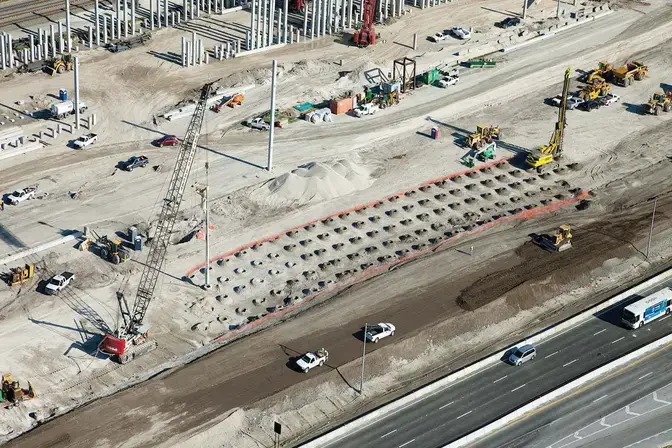
Mass soil mixing (MSM), also known as mass mixing or mass (shallow) stabilization, is a ground improvement technique that improves soft, weak, loose, and compressible soils by mechanically blending them in-situ with either a wet grout slurry or dry cementitious binder to create stabilized soil-cement elements, typically referred to as soilcrete.
Process
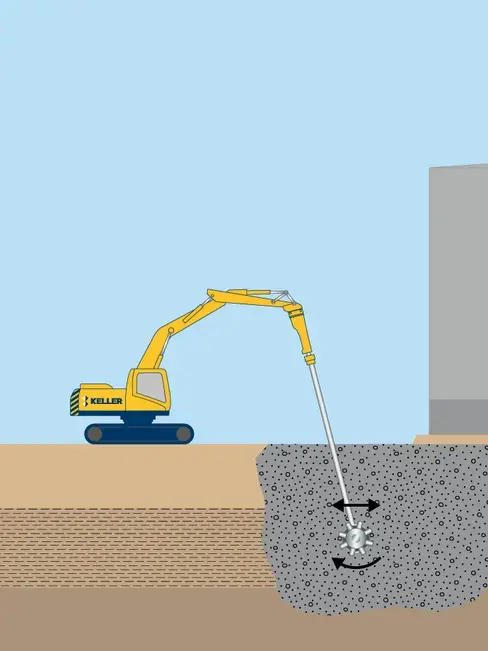
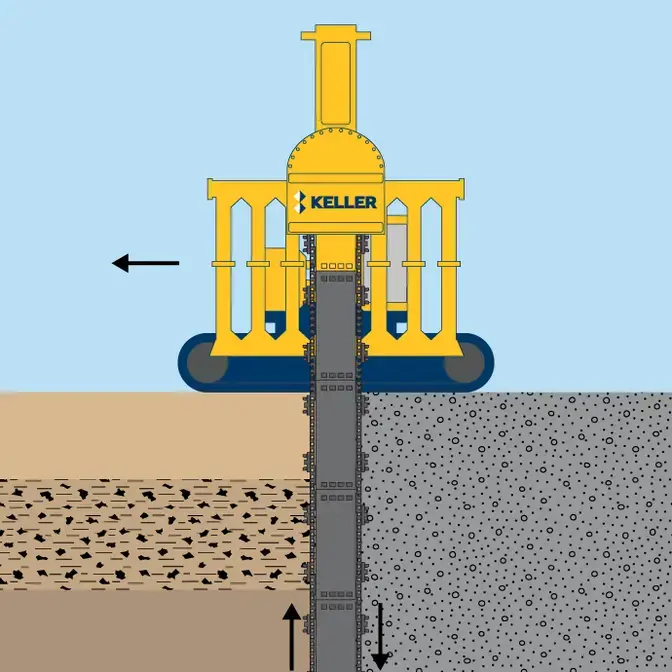
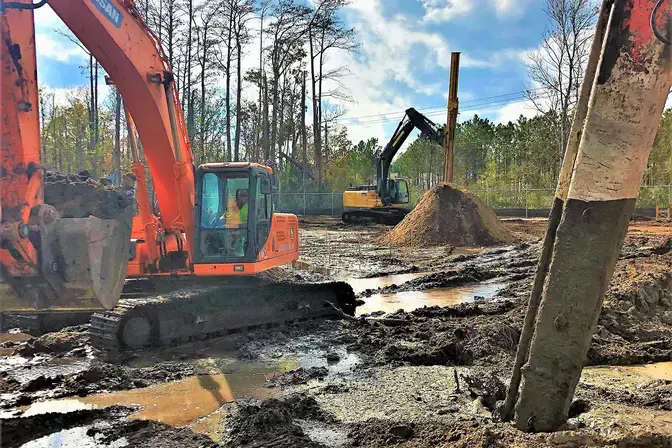
Mass soil mixing is performed using an excavator-mounted hydraulic-powered (rotating drum or blades) mixing tool. During mixing, the rotary tool is pushed vertically and horizontally into the soil. As the tool disaggregates the soil, the cementitious binder is simultaneously pumped through nozzles located on the tool and blended into the soil.
The soilcrete elements are typically constructed in pre-defined ‘cells’ of approximately 5ft x 20ft in plan area. Mixing depths up to 23 ft are possible, although typical depths range from 6ft to 15ft.
The cells can be mixed adjacent to one another to form a 100% mass-stabilized zone, all with a designed unconfined compressive strength and/or permeability. It is low-vibration, quiet, and uses readily available materials.
Large obstructions are pre-excavated and removed ahead of the soil mixing process.
Ideal mass soil mixing ground conditions
Mass soil mixing is applicable to most cohesive and granular soils with low bearing capacity and high compressibility; however, ease of mixing depends on soil type, strength, density, water content, plasticity, stratigraphy, and texture.
Mass soil mixing is also suitable for organic soils, contaminated soils, and high groundwater conditions, but laboratory testing is always recommended before design. Note that for soils with moisture contents at or above the liquid limit (or typically well above 60% moisture content), dry mixing methods may be applicable. Otherwise, mass missing can use a designed wet-grout slurry during mixing.
Related geotechnical techniques
Select a technique:
Common uses
- Increase bearing capacity for foundation support
- Decrease compressibility and settlement
- Mitigate liquefaction and reduce dynamic settlement
- Improve shear capacity and increase slope / global stability
- Temporary shoring for shallow excavations
- Reduce lateral loads for earth retention structures
- Reduce permeability and encapsulate contamination
Advantages
- Quiet and vibration free
- Excess material can be limited and/or reused onsite to limit transporting spoils
- Uses readily available materials
- Can be used individually or combined with other solutions to reduce costs
- Can reduce construction time versus conventional methods
- Can be used to solve numerous geotechnical and groundwater issues
- Experience across North America
Quality assurance
Pre-production laboratory testing is used to evaluate required grout mix design (dry or wet) and validate the installation methodology. A pre-production test program is often performed to validate grout mix and/or binder parameters, installation parameters (grout/binder volume, mixing energy, mixing time), and batching and pumping operations.
Data acquisition systems can be used on all mixing rigs to monitor mixing parameters in real time during the mixing process. Test elements can be excavated for visual inspection of the soilcrete. Wet sampling in fresh elements and coring of cured elements can be used to verify strength and permeability. Visual inspection of the in situ soilcrete elements is possible with a camera lowered into a core hole. In situ testing options for the elements are also available.
Related projects
Education
Encinal High School Stadium Renovations
Keller collaborated with the geotechnical engineer to design a ground improvement solution that addressed seismicity concerns, as required by the California Geological Survey (CGS).
Power
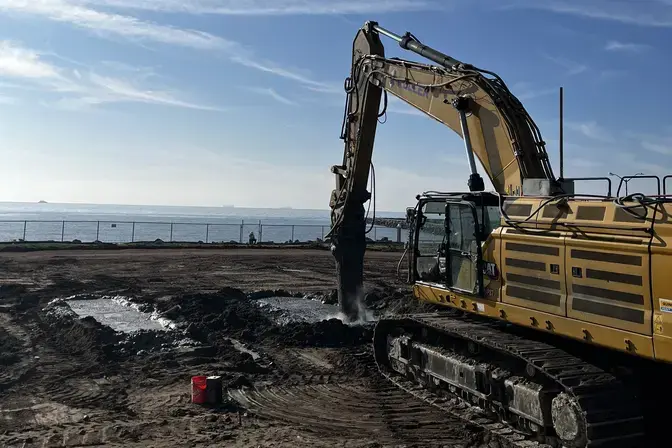
Los Vientos Wind Farm
Keller’s production rate was 33% faster than anticipated, effectively shaving six weeks off the ground improvement project schedule.
Oil, gas and chemical
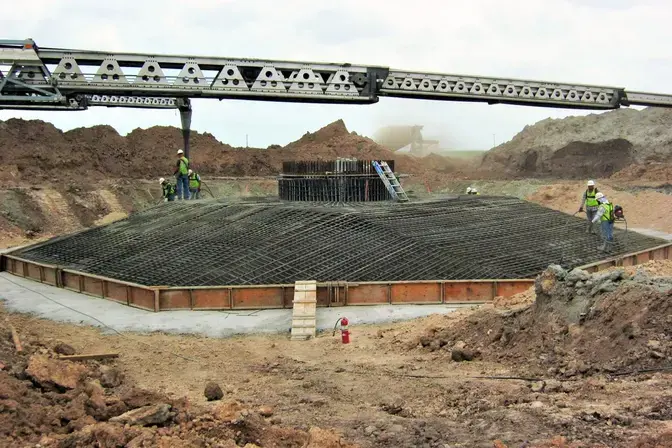
Lees Former Impoundment
Keller finished the work for the project two weeks ahead of the owner’s overall 13-week schedule.
Infrastructure
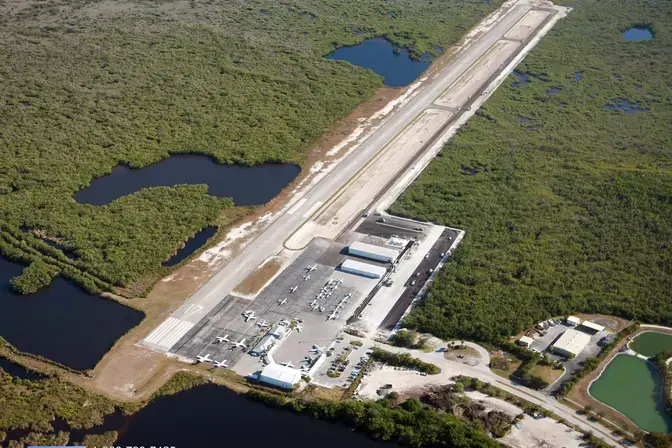
Marco Island Executive Airport
Keller provided a design-build ground improvement solution to support the construction of the new airport.
Infrastructure
Fort Lauderdale Airport Expansion
A new runway was planned on 60 feet of fill, overlying swamp-like soils at the Fort Lauderdale-Hollywood Airport. Ground improvement was used to meet the requirements of the Federal Aviation Administration.