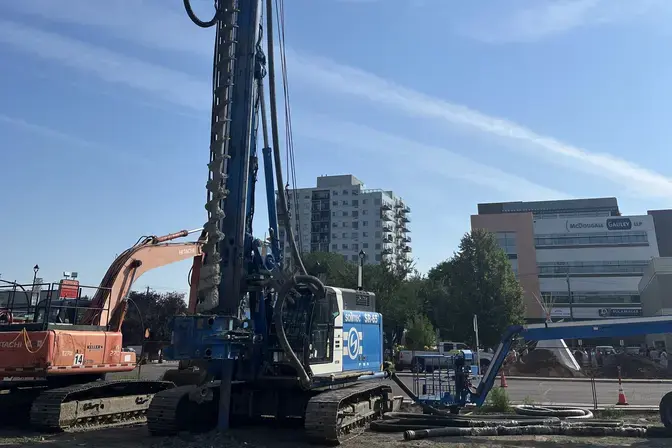
CFA piles, also known as ACIP (augered cast-in-place) piles or auger cast piles, are cast-in-place deep foundation elements constructed using a hollow stem auger with continuous flights.
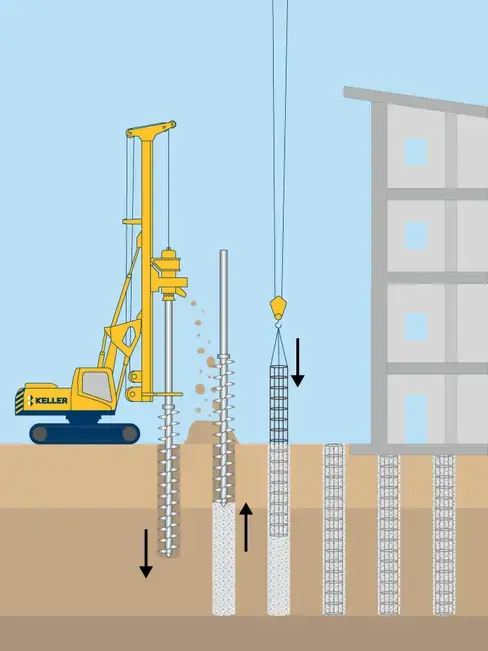
Process
CFA / ACIP piles are constructed by rotating a hollow stem continuous flight auger into the soil to a designed depth. Concrete or grout is pumped through the hollow stem, maintaining static head pressure, to fill the cylindrical cavity created as the auger is slowly removed. The grout pressure and volume must be carefully controlled to construct a continuous pile without defects. The reinforcement cage is placed through the freshly placed concrete.
Typically, Keller CFA / ACIP piles are reinforced with a rigid six-meter-long cage as a minimum, but it’s possible to install much longer cages as and when required by the design or specification. If required, a specially developed vibrator unit can help accurately locate the reinforcement cages.
3D animation
Related geotechnical technique
Select a technique:
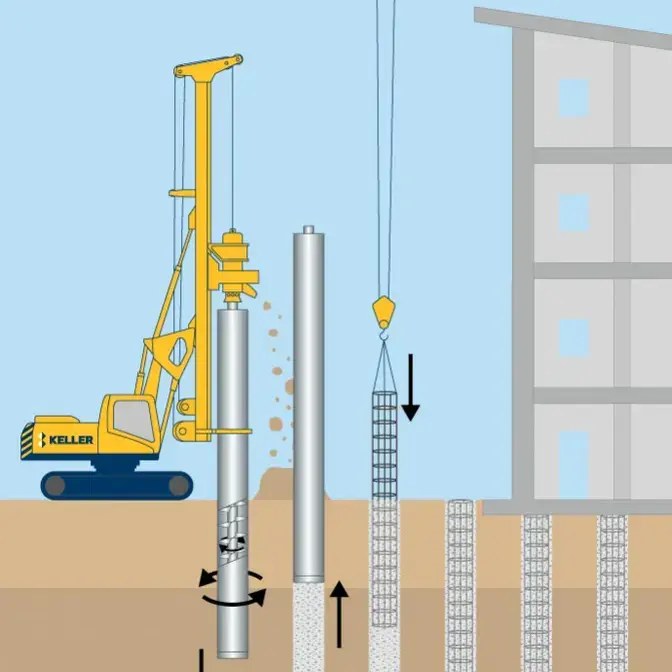
Common uses
- Provide structural support
- Provide earth retention, especially on site boundaries or close to adjacent buildings
- Prevent landslides or protect existing buildings and are often combined with other techniques such as ground anchors or soil nails
Advantages
- Finished foundations element resists compressive, uplift, and lateral loads
- A cost-efficient foundation solution
- Can be installed in most soil conditions such as sands, clays, silts, gravels and soft rock
- Can achieve pile depths in excess of 30m + and with various diameters of 300 mm to 1000mm+
- Low noise levels and no vibration so ideal in built-up areas with weak soil conditions and high levels of groundwater
- Compared to bored piles, construction is very quick as temporary casings or support systems are not required
Quality assurance
Close control of the installation process is essential to ensure the highest quality pile construction. All Keller CFA / ACIP rigs are equipped with sensitive state-of-the-art instrumentation that monitors all aspects of CFA /ACIP piling, including pile depth, auger rotation, penetration rate, concreting pressure, extraction rate, and over-break. The instrumentation produces an individual log for each pile, including element identification, date, time, and operator details.
A documented Quality Management System procedure reinforces this. Quality assurance is achieved through various non-destructive testing methods to evaluate pile integrity and load-settlement performance. The selection of verification techniques is project and application specific.

Related projects
Commercial
Aurora Food Store
Keller installed CFA (auger cast) piles to support the construction of a grocery store in Regina.
Institutional
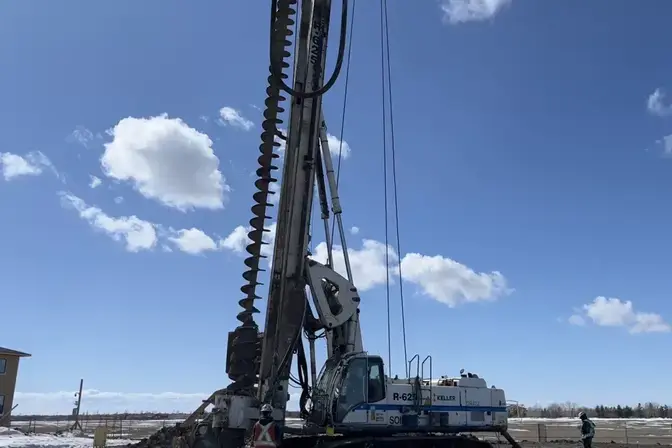
City of Regina Fire Station #8
Keller delivered a cost‑effective design‑build CFA (auger cast) piling solution for the City of Regina’s Fire Station #8.
Residential
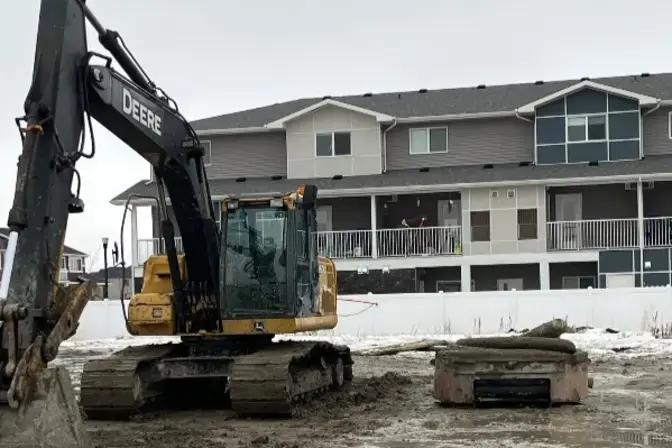
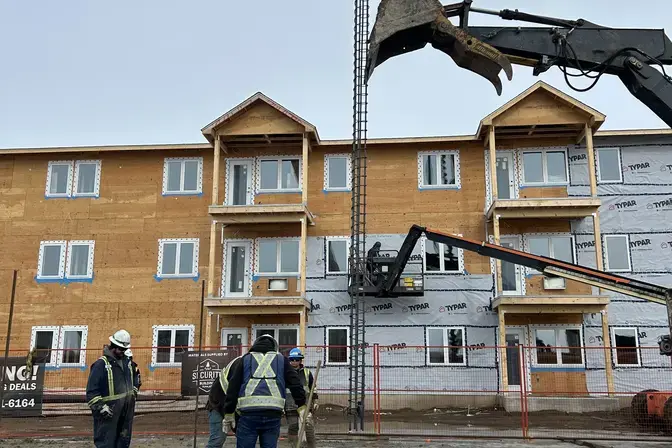
Neville Drive South Apartment
Keller delivered a design-build foundation solution to support a six-story residential development.
Industrial and manufacturing
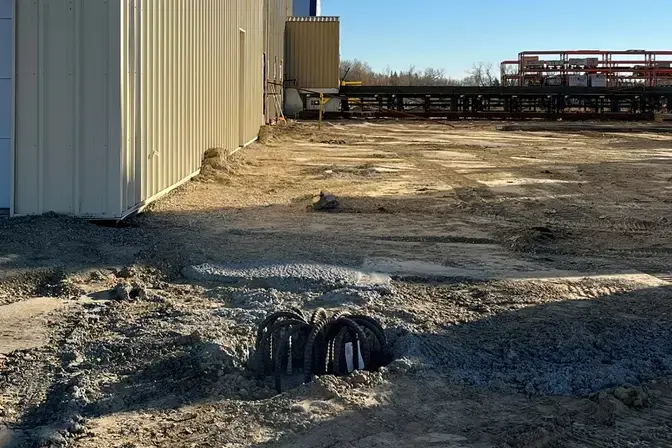
Dutch Industries Crane Foundation
Keller installed CFA piles, providing an efficient, stable foundation solution for an overhead crane system.
Residential
Westcliff Properties
Keller designs and installs 183 CFA (auger cast) piles for new residential development in Saskatoon.