Soil nailing is an earth retention technique that uses grouted, tension-resisting steel elements, called soil nails, to reinforce in situ soils. It is commonly used to stabilize slopes, support excavations, repair retaining walls, and provide temporary or permanent ground support where site access, space, or schedule constraints make other retaining systems less practical.
Process
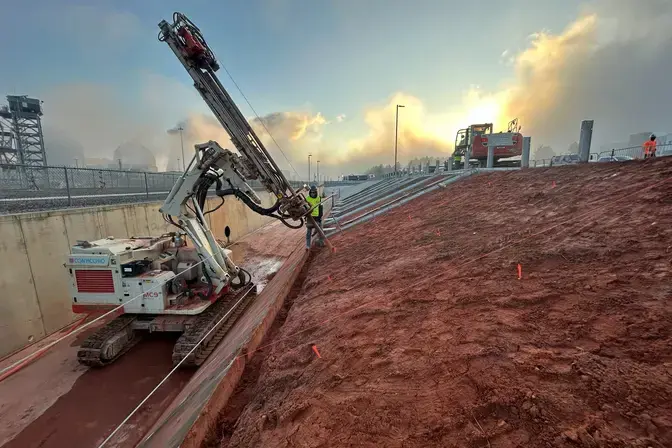
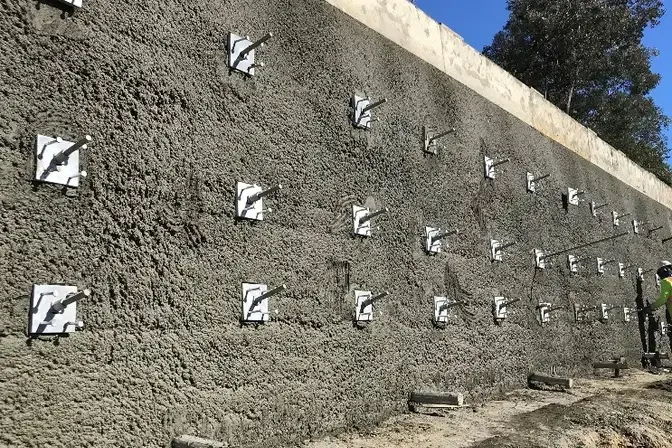
Soil nail walls are generally constructed from the top down. Typically, the soil is excavated in three- to six-foot-deep stages. After each excavation stage, near-horizontal holes are drilled into the exposed face at typically 3- to 6-foot centers, depending on soil conditions. Steel bars are inserted into the holes and grouted in place. These grouted steel elements (soil nails) will create a reinforced block of soil acting as a gravity wall to support the soils beyond it. A drainage system is installed on the exposed face to relieve any water pressure buildup, followed by the application of reinforced shotcrete wall facing to limit surficial spalling. Bearing plates are fixed to the heads of the soil nails.
Temporary soil nail applications
For temporary applications, bearing plates and soil nail hardware can typically be left exposed against the shotcrete face or, in certain situations, installed flush with the shotcrete face to facilitate waterproofing and/or one-sided forming of a CIP wall. For permanent applications, nails can be epoxy-coated or galvanized for corrosion protection, and a permanent reinforced shotcrete wall can be installed.
This installation process is completed in lifts where each lift is excavated, and the above series of activities is repeated until the design wall depth is reached. The finished soil nails form a reinforced block of ground.
Common uses
- Stabilize slopes and landslides
- Support excavations
- Repair existing retaining walls
Advantages
- Equipment is small enough to use in areas with restricted access
- Often a more cost-effective and faster solution for excavation support
- Greater structural redundancy than other earth retention techniques (i.e. anchored soldier piles)
- Can be installed from crane-suspended working platforms for existing steep slopes, such as bluffs or existing retaining walls
- Allows excavation to start at the same time as the shoring system is being installed
- Wall facing alignment is relatively adaptable to curves and bends and can be installed on a batter
Quality assurance
Keller has been installing and developing soil nailing techniques for more than 35 years. We use specialized equipment and experienced crews, and employ strict quality control measures to ensure uniform, consistent results. We have used extensive 3D modeling to avoid conflicts between soil nails and other earth retention systems, as well as with buried utilities/structures.
Testing of the soil nails may include verification and proof testing, along with the specific gravity of the grout and concrete cores taken from the shotcrete.
Related Solutions
Related projects
Infrastructure
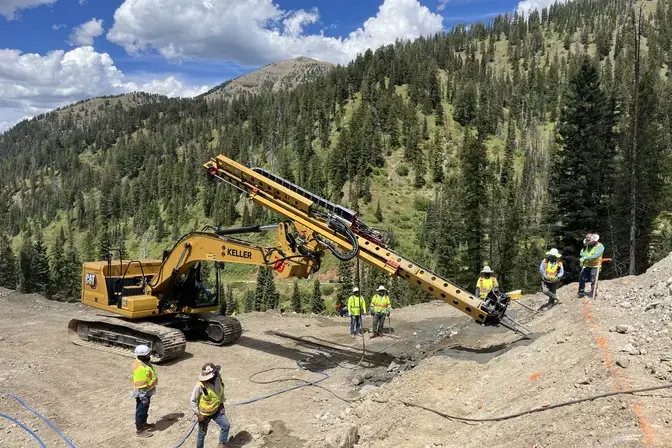
Teton Pass: The Big Fill Slide
Keller provides rapid design and mobilization to perform slope stabilization following a major landslide along Teton Pass.
Commercial
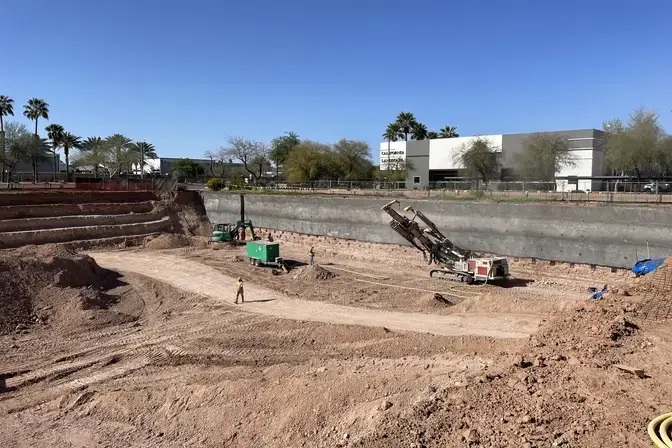
Stellar Airpark Storage
Keller provided complete design and construction for a soil nail support system at Stellar Airpark Storage.
Commercial
Lowe’s of Temecula
Keller installs soil nails to remediate a failing retaining wall protecting a popular home improvement store.
Institutional
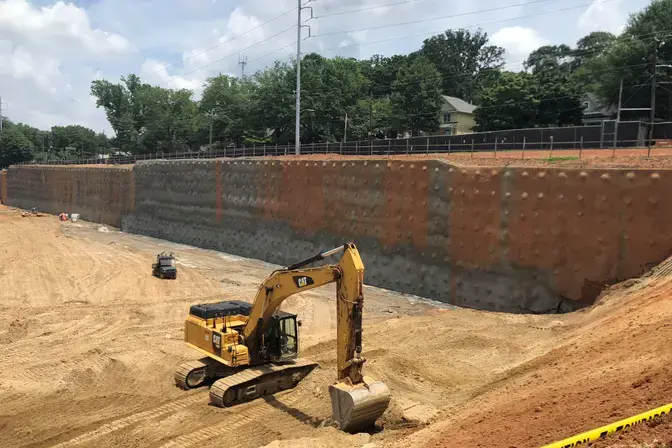
Zoo Atlanta - Grand New View
Zoo Atlanta first opened in 1889 and has undergone several renovations. Keller provided support of excavation as part of the zoo’s newest renovation, the “Grand New View”.
Infrastructure
Rowlett Greenbelt Trail
Adopted in 2001, the Six Cities Trail Plan proposed the construction of several hike and bike trails to form an inter-jurisdictional ‘spine system’ of recreational trails between the Texas cities of Allen, Frisco, Garland, McKinney, Plano, and Richardson. The longest is the 24-mile Rowlett Greenbelt Trail corridor, connecting all six cities.