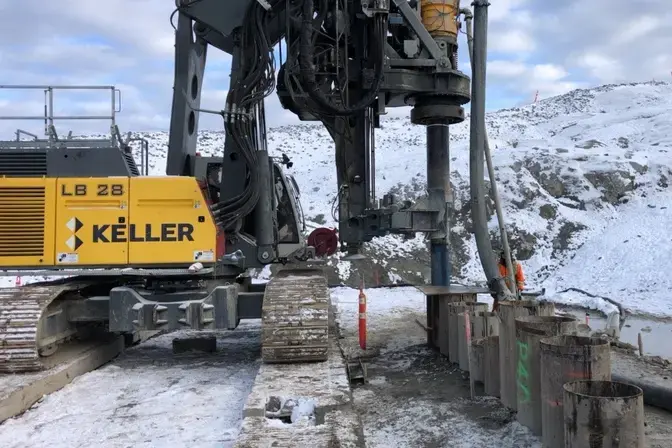
Interlocking pipe piles consist of tightly interlocked pipe piles using an innovative mechanical “ball-and-socket” type connector welded to the full length of the pipe to create a continuous wall that can be temporary or permanent and support groundwater control during construction.
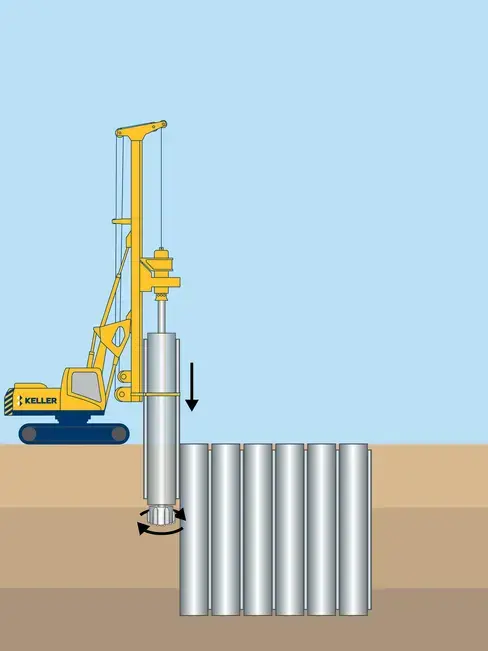
Process
Unlike other excavation support techniques, such as sheet piling and secant pile walls, interlocking pipe piles can be installed through bouldery ground conditions.
A pile guide/template is laid out on the surface to ensure verticality during installation. Interlocking pipe piles are installed using rotary percussion reverse circulation drilling techniques, air/water flush, and a down-the-hole hammer to handle boulders and obstructions.
Accurate determination of top-of-rock elevations allows the pile assembly to be prefabricated off-site. This saves time in the overall installation schedule and is also advantageous where the working area is limited. The pipe pile assembly, complete with an interlock, is advanced to design depth in a single pass and can be readily embedded into the sound rock. Grouting is performed inside the pipe and the annulus space to complete the cut-off.
Common uses
- Support of open excavations
- Groundwater flow barriers
- Flood control barriers in low-lying areas
- Cofferdams
- Dry docks
Advantages
- Rapid, single-pass construction
- Robust technique in challenging ground conditions
- Can be readily installed through bouldery soils
- Mechanical interlocks help manage groundwater control
Quality assurance
A dedicated full-time technician is assigned to perform quality control and quality assurance. This can include pre- and post-wall installation pump tests, pile verticality checks during installation, production pile drill logs and grout logs, and permeability testing to confirm the adequacy of the cut-off wall.
Related projects
Mining
The Island Mine
The Island Mine, owned and operated by Alamos Gold Inc., is an active underground gold mine located on the north shore of Lake Superior. This was Keller's first North American interlocking pipe pile project.