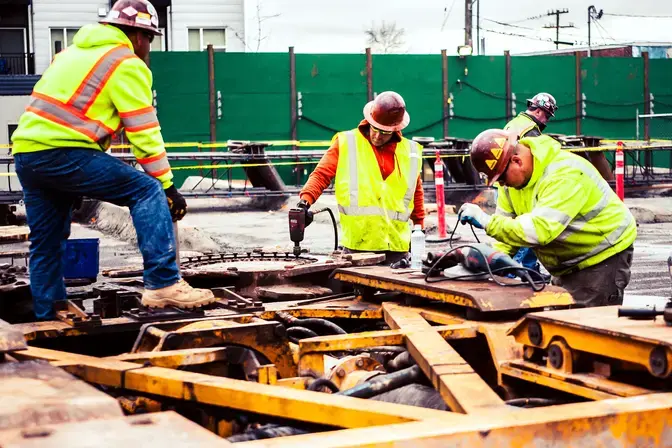
Diaphragm walls are high-stiffness reinforced concrete walls used for excavation support, groundwater cut-off, and permanent retaining wall applications. These walls provide significant resistance to bending from lateral loads and can also serve as a water-resistant barrier in below-grade and deep excavation construction.
Process
Diaphragm walls are designed and constructed as a series of reinforced panels, allowing the overall wall length to be extended with no practical limit for most projects. Individual panels typically range from 10.5 to 30 feet in length, with standard wall thicknesses of 32, 36, 42, 48, and 60 inches. Wall depths regularly exceed 200 feet. Depending on project requirements, diaphragm wall layouts may include right-angle, polygonal, T-shaped, and cross-shaped configurations.
Equipment used for diaphragm wall construction
Mechanical clam shells, also known as cable grabs, are suitable for soft soils, medium-dense to dense soils, and boulders when used in combination with chisels, with suggested excavation depths of up to 120 feet (37 m).
Hydraulic clam shells, also called hydraulic grabs, are suitable for most soil conditions, including dense sands and stiff clays, with suggested excavation depths of up to 260 feet (80 m).
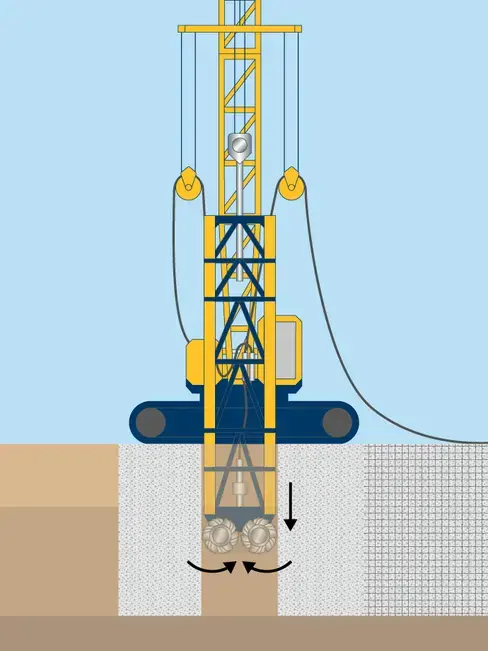
Hydromills, or cutters, are suitable for nearly all soil and rock types. Different cutting wheels can be selected based on site-specific ground conditions. Hydromills can achieve excavation depths greater than 500 feet (150 m) while maintaining very accurate verticality of less than 0.3%, which is important for panel alignment and closure at significant depth.
For large projects involving deep slurry walls and cut-off walls, hydromill construction can offer advantages over conventional clamshell methods, including productivity, reliability, excavation accuracy, and environmental compatibility.
During hydromill excavation, soil is continuously removed from the bottom of the trench, broken down, and mixed with bentonite slurry. The slurry carrying soil particles is pumped to a desanding plant, where it is cleaned and then recirculated back into the trench for reuse.
3D animation
Specialist contacts
Jeff Bean, PE, is Vice President of Major Projects at Keller North America.
He has more than 40 years of experience in geotechnical engineering and geotechnical construction. His expertise includes cutoff walls, diaphragm walls, secant piles, deep soil mixing, dam foundation grouting, jet grouting, compaction grouting, permeation grouting, rock and soil anchors, drilled micropiles, and vibratory ground improvement. In his current role, he provides engineering review, technical guidance, and support for complex geotechnical construction projects.
He holds a Bachelor of Science in Civil Engineering from Lafayette College.
Jorge Gerez Duarte is a Project Executive at Keller North America.
He has held multiple leadership roles with Keller since 2019, including Project Manager, Senior Project Manager, and Project Executive. His experience includes deep foundation and geotechnical construction techniques such as diaphragm walls, large-diameter piling, continuous flight auger (CFA) systems, and tunnel boring machine (TBM) projects.
He holds PMP® certification and studied at Universidade Católica Portuguesa.

Paul Schmall, Ph.D., PE, is Vice President of Business Development at Keller North America.
He has more than 35 years of experience in geotechnical engineering and underground construction, with expertise in groundwater control, dewatering, grouting, ground freezing, tunneling, dam construction and rehabilitation, and forensic investigations of geotechnical failures related to groundwater.
Paul holds a Bachelor of Science in Civil Engineering from Bucknell University and a Ph.D. in Geotechnical Engineering from the University of Nottingham. He is a co-author of the third edition of Construction Dewatering and Groundwater Control and served as President of The Moles, one of North America's leading heavy construction organizations.
Common uses
- Slope stabilization
- Support of open or top-down excavations
- Create barriers to groundwater flow
- Permanent retaining walls
Advantages
- Can be installed close to existing structures and in restricted headroom
- Can be used in conjuction with top-down construction
Quality assurance
Keller maintains a fleet of specialty wall excavation and construction equipment to deliver a wide range of diaphragm wall solutions for excavation support, groundwater control, and structural wall applications.
Related projects
Infrastructure
Parallel Thimble Shoals Tunnel
Keller’s performance and expertise were key to providing deep foundations and excavation support for the area’s first bored transportation tunnel.
Commercial
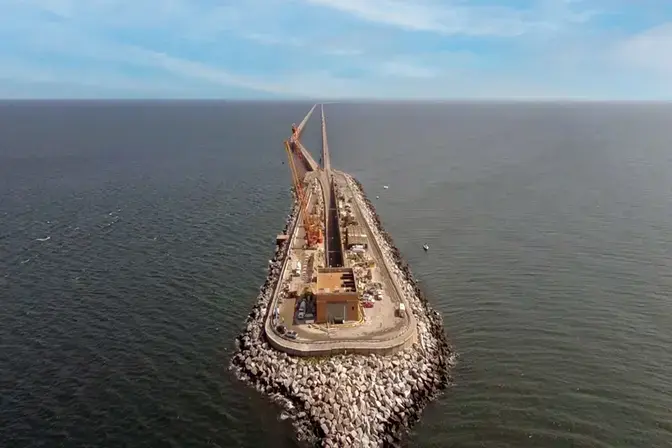
Port Lands Flood Protection
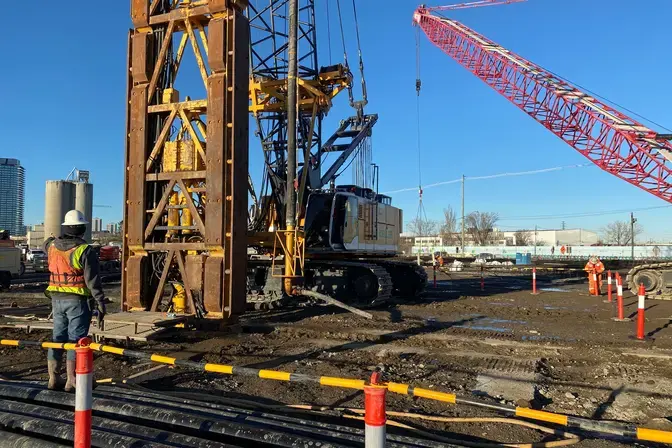
At the mouth of the Don River lies the Toronto Port Lands, a large, underdeveloped stretch of the downtown waterfront, created by infilling one of the largest wetlands in Ontario.
Residential
Transit City Towers 4/5
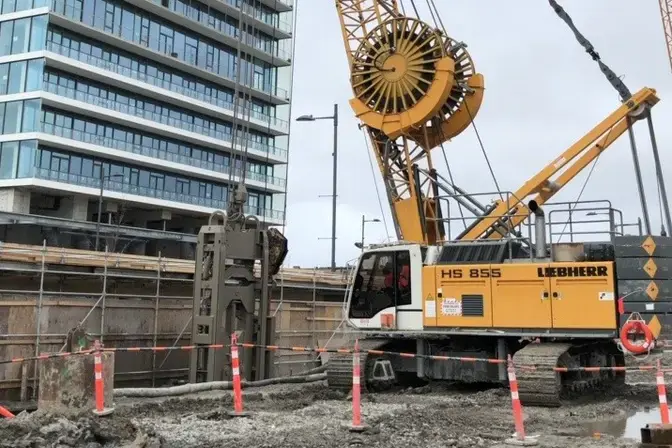
Keller successfully completed the excavation support system, the first use of diaphragm walls in Toronto for a residential high-rise. This project received the 2020 Toronto Construction Association’s Innovation Award.
Infrastructure
Red Rock Hydroelectric
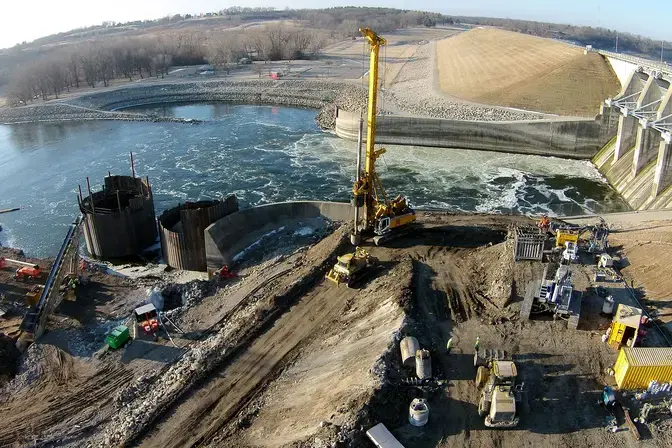
Slurry walls addressed multiple design and dam safety aspects on this challenging project.
Infrastructure
Sound Transit Light Rail - Northgate Link Extension (Contract N125)
By accepting an alternate design concept by means of slurry walls, the project team saved on schedule.