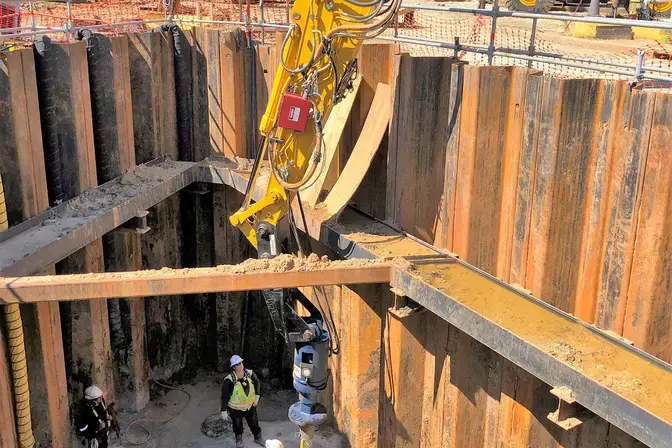
Helical piles are deep foundation elements used to support new structures, underpin existing foundations, and resist compression or tension loads. Also known as screw piles or helical piers, they are installed with minimal vibration and can often be loaded immediately after installation.
Process
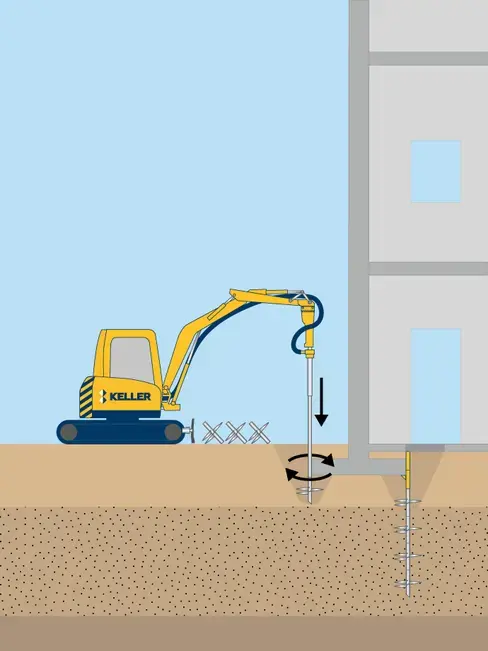
Helical piles are generally installed using standard tracked or wheeled excavators with a torque motor attachment. During installation, the torque is monitored via gauges and/or instrumentation to verify the design capacity. Helical piles are advanced to the predetermined (design) bearing strata by rotating the steel shafts with the torque motor mounted to the excavator plant/rig. Extension steel sections can be used, bolted together, and added to complete the pile depth.
Helical flights, strategically placed along the shaft, assist in penetration without augering or soil removal. The torque is carefully monitored as the pile advances. The final torque reading is taken over the last 1m of advancement to ensure the pile achieves the required design before terminating at the correct datum level.
Upon completion, the top of the pile can be connected to the structure in various ways, including a direct steel flange plate connection or a plate/rebar connection to concrete.
Helical pile capacities
Helical piles are commonly used in compression for ultimate capacities around 50 -150 kips; larger shafts may reach over 300 kips. In tension, the ultimate capacity may reach 50 kips. Conventional vertical helical piers provide minimal lateral capacity. However, Keller can construct helicals with a larger diameter collar, large diameter helicals, and/or battered helicals to increase lateral capacity
A detailed understanding of the subsurface conditions (especially soil strata type, layer thickness levels, and strength (SPT ‘N’ Values) to depth is necessary to interpret the required design and torque capacities properly.
Common uses
- Structural support (compression or tension) for both permanent and temporary structures
- Underpin existing foundations
Advantages
- Permanent or temporary applications
- Have a range of sizes and capacities
- For temporary structures, Removable using the same equipment and method, reducing environmental impact
- No vibration during installation
- Can be loaded immediately upon completion, reducing project schedule and cost
- Can be installed in all weather conditions
- No drill spoils
- Can be installed in many soil conditions
Quality assurance
Keller draws upon a wealth of knowledge and experience to offer and deliver the optimal helical pile solution. Static load testing can be used to monitor performance and confirm that the required settlement criteria are met.

Related projects
Institutional
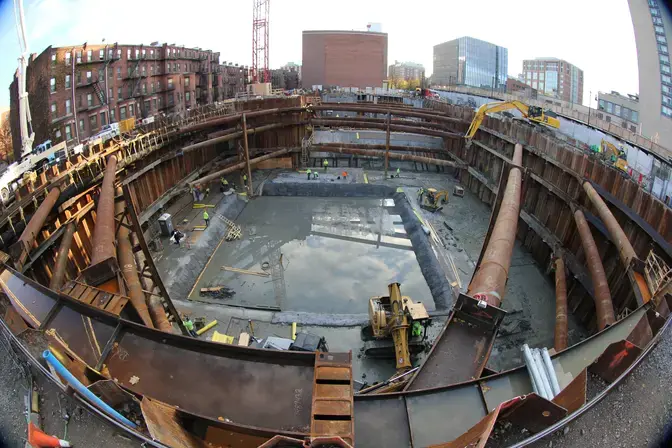
Boston University Center for Computer & Data Sciences
With its unique, award-winning design resembling a cantilevered stack of books, the Center for Computing & Data Sciences is a striking addition to the University's Central Campus located along the Charles River. Keller collaborated early on with the design team to provide technical and constructability guidance for the foundation work.
Institutional
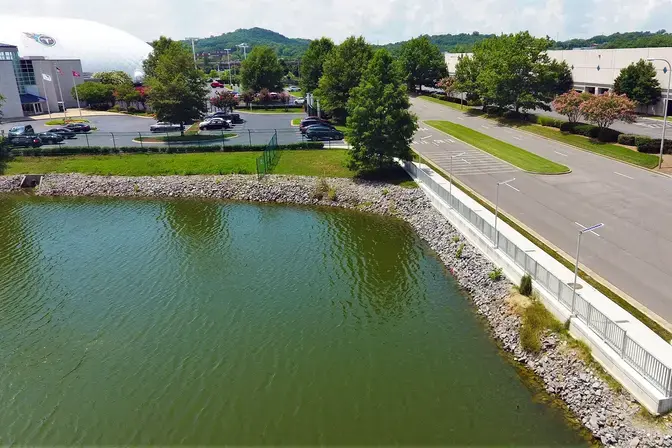
Titan’s Practice Facility Sidewalk
Keller finalized the design, safely circumvented utility lines beneath the sidewalk alignment, and completed the foundation support in just four days, including mobilization and demobilization.
Industrial and manufacturing
Petrochemical Sump and Pipe Support
Keller completed the sheet pile and helical pile installation in restricted access conditions safely and on time in a busy petrochemical facility.