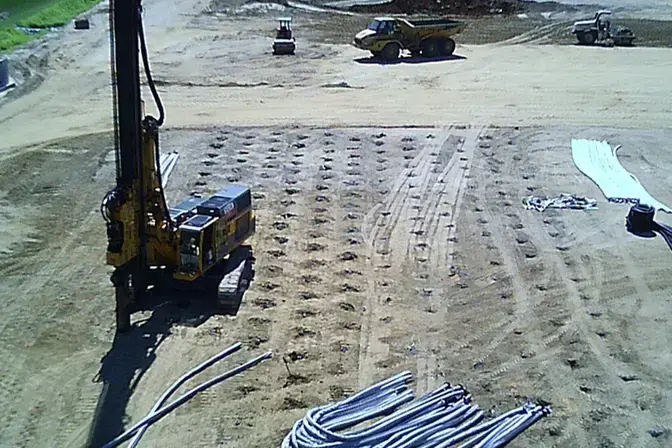
The earthquake drain ground improvement method minimizes bearing capacity failures and settlement during and immediately after a seismic event. It mitigates liquefaction by limiting excess pore pressures generated during seismic events to levels less than those that could trigger liquefaction.
Process
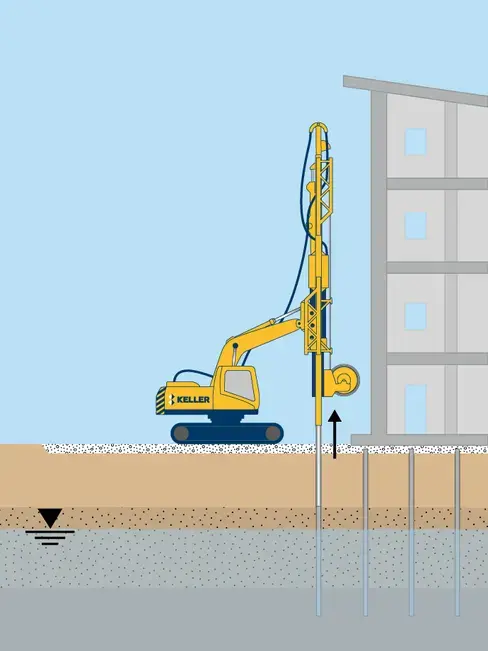
Earthquake drains are installed by vibrating the insertion mandrel during penetration and removal. Typically, the insertion mandrel consists of a heavy-gauge steel pipe with three equally spaced fins to transfer vibrations to the adjacent soil. The vibrations result in some densification of the granular soils, assisting in the liquefaction mitigation.
The nominal 75mm (3 inches) diameter drain core is tightly wrapped with geotextile filter fabric (selected for its filtration properties), allowing free access of pore water into the drain while preventing the piping of fines from adjacent soils. The geotextile wrap is durable and can withstand handling and abrasion during installation. Several core designs and fabric types can be used to fit a variety of drainage applications and soil classifications.
Liquefaction mitigation achieved with earthquake drains can be valuable for support of embankments, reduction of lateral spreading from seismic loading, containment of densified ground, support of floor slabs in certain conditions, liquefaction mitigation of mine tailings, and reducing seismic deformations of pile groups. Combined with other ground improvement techniques, earthquake drains can be applied to big box stores, mid-rise buildings, tanks, ports, and hydraulic fills.
Common uses
- Mitigate liquefaction
- Reduce seismic settlement
- Stabilize seismic slopes
- Prevent lateral spreading
- Accelerate consolidation of cohesive soils
Advantages
- Allows the use of shallow foundations to support structures on liquefiable soils
- Efficient and cost-effective compared to other liquefaction mitigation techniques
- Can be used in conjunction with other ground improvement techniques on sites where static settlement is an issue and with deep foundation systems to reduce the liquefaction potential of the soils surrounding the deep foundation members
- Construction works can, in most cases, start immediately after ground improvement
- No spoil
Quality assurance
Keller is highly experienced in designing and constructing this technique and has designed and installed millions of meters of earthquake drains.
Related projects
Industrial and manufacturing
Alro Steel Expansion
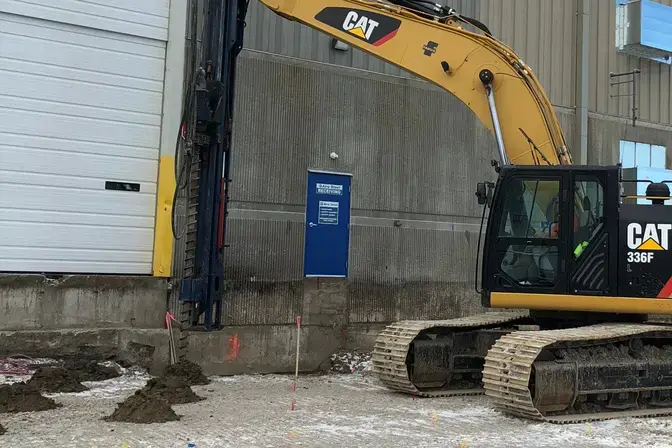
The 120-mile-long New Madrid Seismic fault line is one of the most prominent and historic seismic zones east of the Rocky Mountains. The probability of soil liquefaction and consequent above-ground structural damage and/or settlement during a seismic event often requires ground improvement for buildings supported on shallow foundations.
Infrastructure
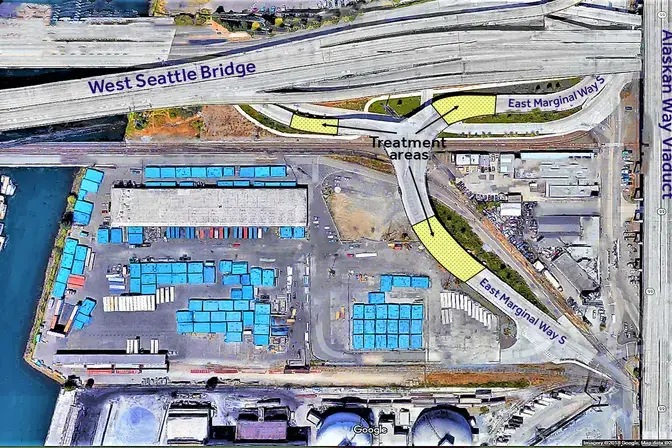
East Marginal Way South
Keller provided a turn-key liquefaction mitigation ground improvement solution, allowing the client to begin above grade construction immediately after completion of our work.
Infrastructure
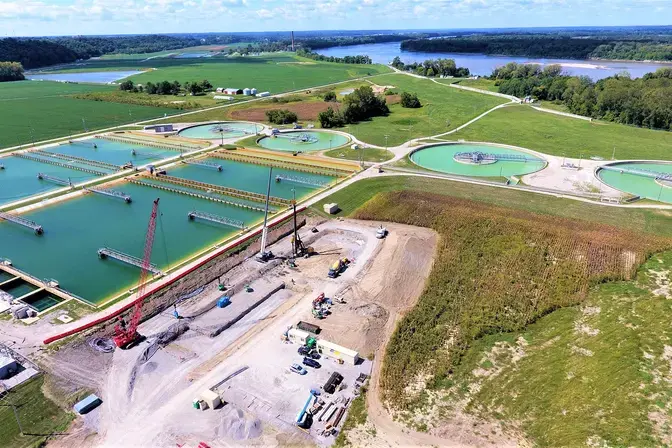
Generator Pad Addition
Keller’s design-build approach delivered the most cost- and schedule-effective ground improvement solution to satisfy the static and seismic requirements of the project.
Institutional
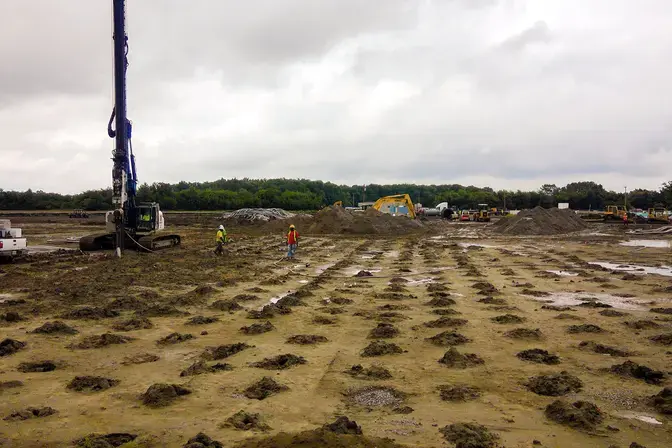
Baptist Memorial Hospital – Crittenden
Keller combined vibro piers with earthquake drains (EQDs) for a cost-effective alternative to applying deep foundations solutions.
Commercial
Walmart SuperCenter
Keller designed and installed an earthquake drain system to mitigate liquefaction concerns for a new Walmart SuperCenter.